
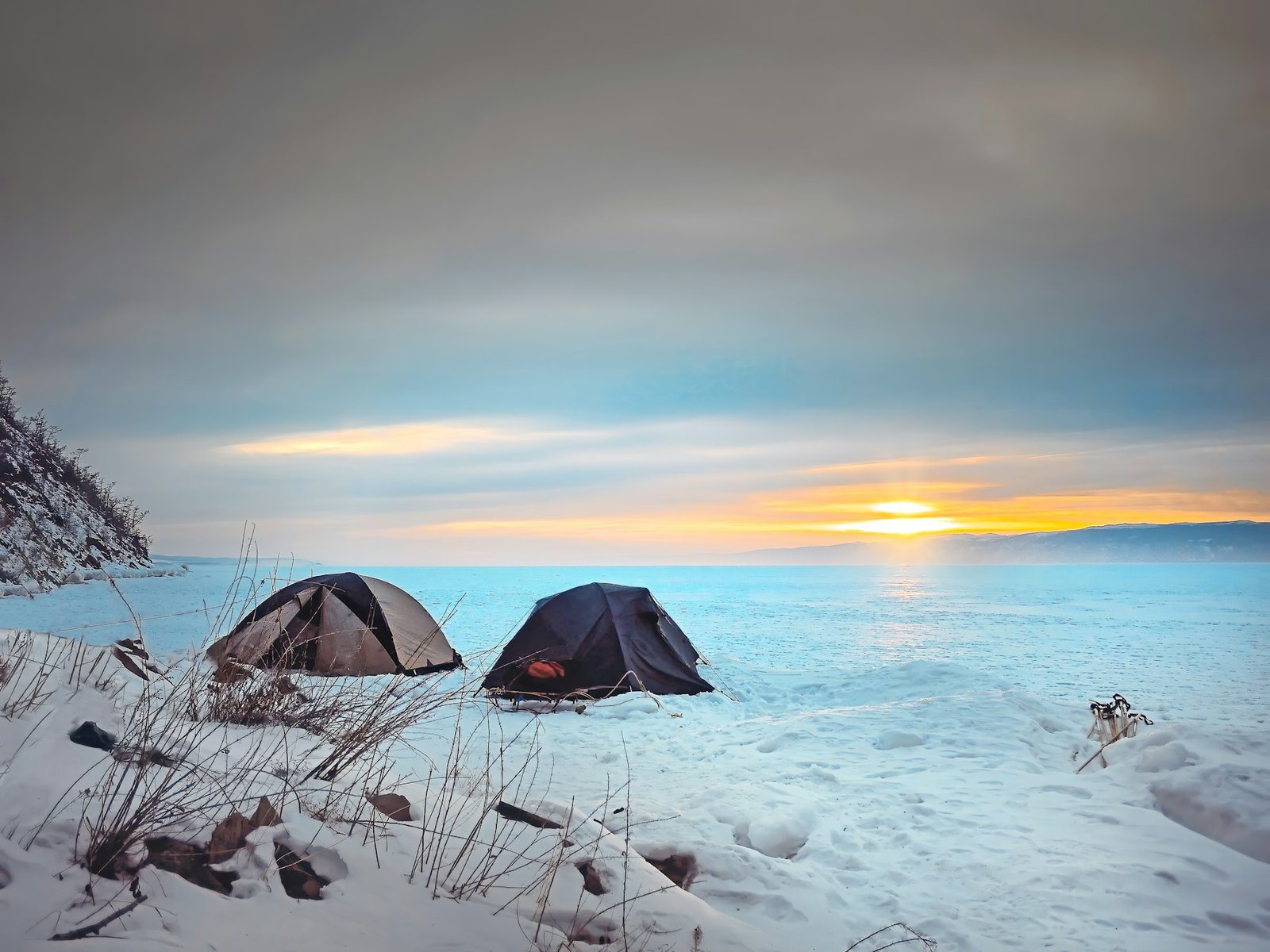
The season rating on a tent describes the conditions it was designed for, not how many months of the year you can use it. The real dividing line is snow and strong wind.
3-season tents
Three-season tents are made for spring, summer and autumn: rain, wind, cool nights and insects. Typical features:
- A lot of mesh in the inner tent for ventilation and to reduce condensation on warm, humid nights.
- Light poles and fabrics, often in a simple hubbed or crossing-pole design, to keep weight down.
- A fly that stops short of the ground at the edges, which lets air flow through.
- Moderate wind resistance when pitched and guyed properly.
Most backpacking tents fall into this category. The lightweight two-person tents in our directory, such as NEMO’s Dragonfly OSMO and MSR’s Hubba Hubba NX, are both listed by their makers as 3-season designs with mesh canopies.
3-season tents compared
Every tent here is listed as a 3-season design. Lightest first; figures come from each maker or an authorized retailer.
| Product | Weight | Floor | Doors | Peak height | Pitch | Price | Where to buy |
|---|---|---|---|---|---|---|---|
| NEMO EquipmentNEMO Hornet OSMO 1PUltralight solo | 1 lb 13 oz / 822 g | 20.6 sq ft / 1.91 m² | 1 | 39 in / 99.1 cm | Semi-freestanding | $$ | View optionsat Amazon · Paid link |
| Big AgnesBig Agnes Copper Spur UL1Freestanding solo | 2 lb / 907 g | 20 sq ft / 1.86 m² | 1 | 38 in / 96.5 cm | Freestanding | $$ | View optionsat Amazon · Paid link |
| Big AgnesBig Agnes Tiger Wall UL2Two doors, light | 2 lb 3 oz / 992 g | 28 sq ft / 2.6 m² | 2 | 39 in / 99.1 cm | Semi-freestanding | $$ | View optionsat Amazon · Paid link |
| Big AgnesBig Agnes Copper Spur UL2Near-vertical walls | 2 lb 10 oz (≈1.19 kg) | 29 sq ft (≈2.69 m²) | 2 | 40 in (≈102 cm) | Freestanding | $$$ | View optionsat Amazon · Paid link |
| NEMO EquipmentNEMO Dragonfly OSMO 2PTwo doors, freestanding | 2 lb 10 oz / 1.2 kg | 29.0 sq ft / 2.7 m² | 2 | 41 in / 105 cm | Freestanding | $$$ | View optionsat Amazon · Paid link |
| MSRMSR Hubba Hubba NX 2Big vestibules | 3 lb 7 oz / 1.54 kg | 29 sq ft / 2.7 m² | 2 | 39 in / 100 cm | Freestanding | Not listed | View optionsat Amazon · Paid link |
| MSRMSR Elixir 2Footprint included | 5 lb 2 oz / 2.33 kg | 30 sq ft / 2.82 m² | 2 | 41 in / 104 cm | Freestanding | $ | View optionsat Amazon · Paid link |
Price: $ under $400 · $$ $400–549 · $$$ $550+, from each maker's US list price (checked October 2026). Sale prices at retailers vary; check the current price before you buy.
Where they struggle: wet, heavy snow loading the fly, spindrift blowing through mesh, and sustained high winds on exposed ground.
4-season tents
“Four-season” usually means mountaineering or winter tents built to stand up to snow and wind. Expect:
- More poles and more pole crossings, so the structure spreads snow load and resists flattening.
- Stronger, heavier fabrics and more guy-out points.
- Solid fabric panels instead of mesh, to keep out spindrift and hold warmth.
- A fly that reaches the ground, sometimes with snow flaps you can bury.
- Vestibules sized for boots, packs and sometimes careful cooking in bad weather.
The trade-offs are weight, price and comfort in summer. A fully enclosed tent can feel stuffy and gather condensation on a warm night.
In between: “3+ season” and convertible tents
Some tents add an extra pole, more fabric in the inner, or zip panels over the mesh. Brands call these 3+ season, 3–4 season or convertible. They suit shoulder-season trips with cold nights and the odd dusting of snow, but they’re not a substitute for a true mountain tent in a storm.
How to choose
| If your trips look like… | Consider |
|---|---|
| Summer backpacking, valleys and forests | A 3-season tent; prioritize weight and ventilation |
| Spring and autumn in the hills, cold nights, maybe light snow | A sturdier 3-season or a 3+ season tent; check the guy-out points |
| Winter camping above the treeline, expeditions, heavy snow | A 4-season mountaineering tent |
| Car camping in mild winter conditions | A robust 3-season tent may be enough if you avoid snow loading and exposed sites |
Whatever the rating, pitch carefully: tension the fly, use all the guy lines in wind, and choose a sheltered spot. Good site selection does more for a tent’s weather resistance than the label on the bag.
To compare tents side by side, use the tent comparison or browse 3-season tents.
Sources
- NEMO Equipment — Dragonfly OSMO specifications (season rating, mesh canopy) (accessed Oct 6, 2026)
- Cascade Designs (MSR) — Hubba Hubba NX specifications (3-season) (accessed Oct 6, 2026)