
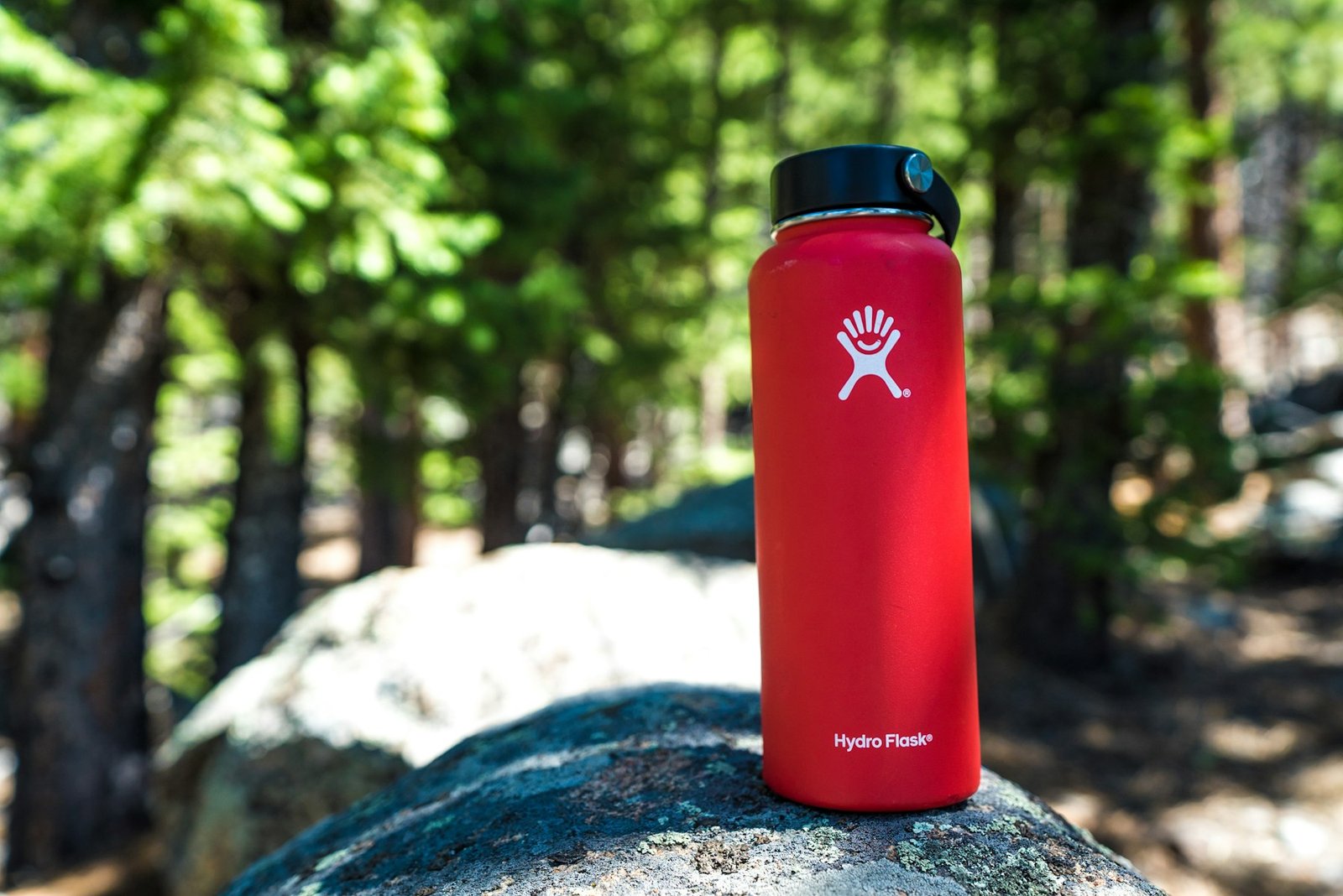
A liter of water weighs a kilogram (about 2.2 lb), so carrying water is a balancing act: enough to stay safe between sources, not so much that the load wears you down.
How much to carry
A common starting point is about half a liter per hour of moderate hiking in moderate temperatures. Strenuous hiking in high heat can call for a liter or more per hour, and you’ll need extra at altitude, where it’s easy to get dehydrated without feeling thirsty.
To plan a day:
- Look at the map for reliable water sources and the distance between them.
- Estimate the hours between sources at your pace, including climbs.
- Multiply by your hourly need, then add a margin for heat, a slower pace or a dry source.
- Add water for camp: cooking dinner and breakfast, and something to drink overnight.
Check recent trip reports or ranger information for seasonal sources. Springs and streams marked on a map can be dry in late summer.
Bottles or a hydration reservoir?
Bottles (hard plastic, lightweight disposable-style bottles or soft collapsible flasks)
– Easy to fill, check and refill, and to see how much you have left.
– Simple to use with most filters.
– You have to stop, or carry them where you can reach them, to drink.
Hydration reservoirs (a bladder with a drinking tube)
– Let you sip while walking, which helps many people drink little and often.
– Hard to see how much is left, and refilling means opening up the pack.
– Tubes can freeze in cold weather; blowing water back into the reservoir after each sip helps.
Many backpackers carry a reservoir for drinking on the move plus a bottle or two for camp, filtering and backup. Collapsible containers are useful for carrying extra water to a dry camp, since they pack small when empty.
Where to carry it
Water is dense, so keep heavy loads close to your back and roughly between your shoulder blades in the pack. Side pockets work for one bottle each side and keep the load balanced. In freezing weather, keep bottles inside the pack or in an insulated sleeve, and store them upside down: water freezes at the top first, so the lid stays clear.
Treating backcountry water
Even clear mountain streams can carry bacteria, parasites or viruses. The CDC’s backcountry guidance summarizes the main options:
| Method | Notes |
|---|---|
| Boiling | The most reliable method. Bring to a rolling boil for 1 minute, or 3 minutes above 6,500 ft (about 2,000 m). Uses fuel and time. |
| Filtering | Effective against bacteria and parasites with a fine enough filter (0.3 micron or smaller for bacteria, and certified for cyst and oocyst reduction). Not effective against viruses on its own. |
| Chemical disinfection | Iodine and chlorine work against bacteria and most viruses but not Cryptosporidium. Chlorine dioxide is effective against Cryptosporidium. Follow the product’s contact time, which is longer in cold water. |
| Filter plus disinfection | Covers bacteria, parasites and viruses. A good approach where human or animal contamination is likely. |
Collect water from flowing sources where you can, upstream of trails and camps, and let silty water settle or pre-filter it through a cloth so filters last longer.
A simple checklist
- Know where your next two water sources are, and whether they’re reliable this season.
- Carry enough to reach the second one if the first is dry.
- Start each stretch with full containers and drink before you’re thirsty.
- Carry a backup treatment method, such as tablets alongside a filter.
- Protect filters from freezing; a frozen filter may be damaged without looking any different.
Sources
- REI Expert Advice — How to stay hydrated on the trail (accessed Oct 6, 2026)
- CDC — A Guide to Drinking Water Treatment and Sanitation for Backcountry and Travel Use (PDF) (accessed Oct 6, 2026)