
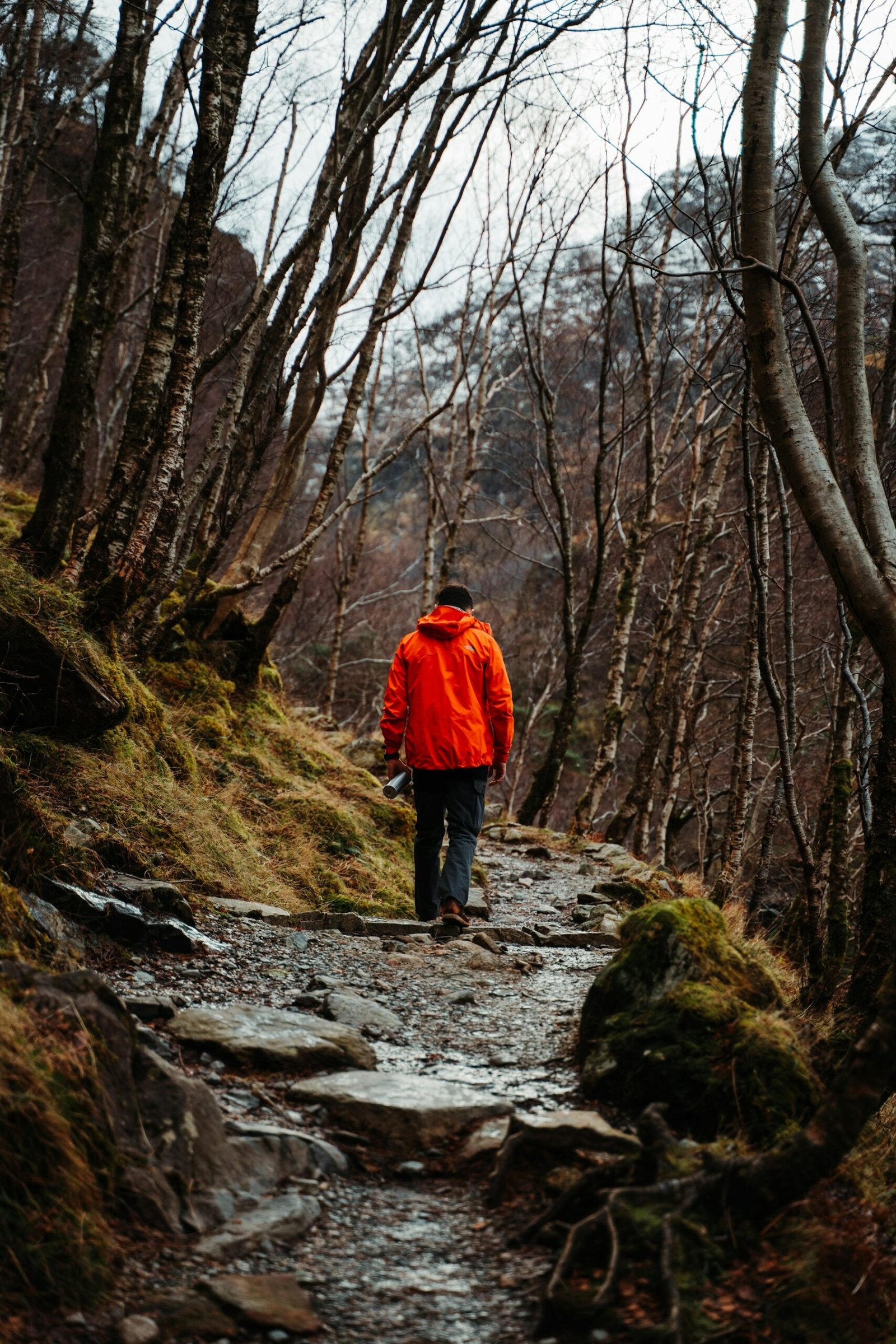
A waterproof jacket has two jobs that pull against each other: keep rain out and let the water vapor from your sweat escape. Breathability ratings try to put a number on the second job. They’re useful, but only if you know which test produced them.
The two common measurements
MVTR (moisture vapor transmission rate) is shown in grams per square meter per 24 hours (g/m²/24h). It says how much water vapor passed through a square meter of fabric in a day under lab conditions. Higher is more breathable. You’ll see figures like 10,000, 20,000 or 30,000 g/m²/24h.
RET (resistance to evaporative heat transfer) comes from a “sweating hot plate” test defined in ISO 11092. It measures how strongly the fabric resists the escape of moisture. Lower is more breathable. A commonly used scale reads:
| RET | Typical description |
|---|---|
| Under 6 | Extremely breathable |
| 6–12 | Very breathable |
| 12–20 | Moderately breathable |
| Over 20 | Not very breathable |
Why two g/m²/24h numbers often can’t be compared
MVTR has several test methods. Some place the fabric over a cup of desiccant, others turn the cup upside down so water sits against the fabric, and the conditions differ. The same fabric can score very differently depending on the method, sometimes several times higher in one test than another. Brands don’t always say which method they used.
So a jacket listed at 30,000 g/m²/24h isn’t necessarily more breathable than one at 20,000 from another brand. Compare MVTR figures only within one brand’s range, or when both name the same test. RET figures from ISO 11092 are more consistent across brands, which is one reason some manufacturers publish them instead.
What matters more than the number
Ventilation beats membranes. Pit zips, a two-way front zip and mesh-lined pockets that double as vents move far more air than any membrane can. If you work hard in the rain, look at venting options first.
The face fabric has to stay dry. Membranes move vapor best when the outside of the jacket isn’t saturated. Once the water-repellent finish wears and the face fabric wets out, breathability drops sharply. Wash and reproof according to the manufacturer’s care label.
Your layers count. A cotton T-shirt holds sweat against you whatever the shell. Synthetic or wool base layers move moisture to where the jacket can deal with it.
Some condensation is normal. In cold, humid weather, vapor can condense on the inside of any shell before it escapes. Damp sleeves after a steep climb don’t mean the jacket is leaking.
A practical way to choose
- Walking in mild, wet weather at an easy pace: most mid-range rain jackets are fine. Prioritize fit, hood and venting.
- Fast hiking, running or climbing in the rain: look for a low RET (under about 12) or a brand’s most breathable membrane, plus vents.
- Cold, windy mountain days: durability and weather protection usually matter more than the last bit of breathability.
Pair this with the waterproof ratings guide, since the two numbers together describe the trade-off a shell is making.
Shells to compare
Few brands publish a breathability number, so venting features are often the more useful thing to compare. Pit zips, a mesh lining and a stretch soft shell each change how a jacket feels on a climb; the spec sheets list which jackets have them.
Jackets compared
Lightest first. Figures come from each maker or an authorized retailer.
| Product | Weight | Type | Waterproofing | Price | Where to buy |
|---|---|---|---|---|---|
| Outdoor ResearchOutdoor Research Helium UL JacketUltralight packable | 5.7 oz / 162 g | 2.75-layer waterproof/breathable rain shell | Toray Dermizax 2.75L on 15D nylon ripstop | $$ | View optionsat Amazon · Paid link |
| RabRab Borealis Hooded JacketBreathable soft shell | 9.6 oz / 273 g | Single-layer softshell | No membrane | $ | View optionsat Amazon · Paid link |
| MarmotMarmot PreCip Eco Rain JacketPit zips, packs in pocket | 11 oz / 305 g | Waterproof/breathable rain jacket | Marmot NanoPro Eco | Not listed | View optionsat Amazon · Paid link |
| Arc'teryxArc’teryx Beta JacketGore-Tex all-rounder | 13.2 oz / 375 g | 3-layer waterproof/breathable hard shell | GORE-TEX ePE | $$$ | View optionsat Amazon · Paid link |
| PatagoniaPatagonia Torrentshell 3L Rain Jacket3-layer everyday rain shell | 14.1 oz / 400 g | 3-layer waterproof/breathable rain shell | PU membrane with 13% biobased content | $$ | View optionsat Amazon · Paid link |
| Helly HansenHelly Hansen Verglas 3L Shell Jacket 2.0Helmet-ready mountain shell | 22.9 oz / 650 g | 3-layer waterproof/breathable hard shell | HELLY TECH Professional | Not listed | View optionsat Amazon · Paid link |
| Black DiamondBlack Diamond StormLine Stretch Rain ShellStretchy, packs small | Not listed | Waterproof rain shell with stretch fabric | BD.dry | Not listed | View optionsat Amazon · Paid link |
| The North FaceThe North Face Antora JacketMesh-lined everyday shell | Not listed | 2-layer waterproof/breathable rain jacket | DryVent 2L on 70D x 70D recycled nylon ripstop | $ | View optionsat Amazon · Paid link |
Price: $ under $150 · $$ $150–299 · $$$ $300+, from each maker's US list price (checked October 2026). Sale prices at retailers vary; check the current price before you buy.
Sources
- Decathlon — How do you measure the breathability (RET) of a material? (accessed Oct 6, 2026)